Skip to content

Cheminformania

  • Cheminformania Consulting
  • Blog
  • About
    • About Cheminformania
    • Esben Jannik Bjerrum
  • Cheminformania Consulting
  • Blog
  • About
    • About Cheminformania
    • Esben Jannik Bjerrum

Cheminformatics in Excel part 2: RDKit4Excel

Esben Jannik Bjerrum/ November 21, 2017

Previously I wrote about how to use the xlwings project to get RDKit functionality directly in Excel. Well, it wasn’t that directly as there were some intermediate
Read More

Cheminformatics in Excel: linking RDKit with Xlwings

Esben Jannik Bjerrum/ August 11, 2017

Excel is widely used in businesses all over the world and can be used for many diverse tasks due to the flexibility of the program. I’ve been

Read More

Can children fold proteins?

Esben Jannik Bjerrum/ July 31, 2017

Can children fold proteins? During the summer holidays I volunteered to hold a workshop about protein folding at the summer camp for Gifted Children Denmark. The idea
Read More

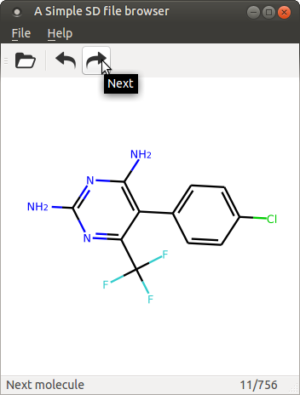
Programming a simple molecular GUI browser with model-view architecture (MVC) using Python with PySide or PyQt and RDKit

Esben Jannik Bjerrum/ June 2, 2017

One of the more popular blog post based on monthly visitors is the old Create a Simple Object Oriented GUIDE GUI in MatLAB, but since I don’t

Read More

Better Deep Learning Neural Networks with SMILES Enumeration of Molecular Data

Esben Jannik Bjerrum/ March 23, 2017

The process of expanding an otherwise limited dataset in order to more efficiently train a neural network is known as Data Augmentation For images there have been
Read More

Tune your deep tox neural network with free tools

Esben Jannik Bjerrum/ February 7, 2017

In another blog post I demonstrated how to build a deep neural network with Keras in Python to model some toxicity dataset from the Tox21 challenge. The

Read More

A deep Tox21 neural network with RDKit and Keras

Esben Jannik Bjerrum/ January 15, 2017

I found some interesting toxicology datasets from the Tox21 challenge, and wanted to see if it was possible to build a toxicology predictor using a deep neural

Read More

A deeper look into chemical space with neural autoencoders

Esben Jannik Bjerrum/ January 3, 2017

In the last blogpost the battle tested principal components analysis (PCA) was used as a dimensionality reduction tool. This time we’ll take a deeper look into chemical
Read More

Peeking into the chemical space using free tools

Esben Jannik Bjerrum/ December 19, 2016

As covered before, chemical space is huge. So it could be nice if this multidimensional molecular space could be reduced and visualized to get an idea about

Read More

Molecular neural network models with RDKit and Keras in Python

Esben Jannik Bjerrum/ December 6, 2016

Neural networks are interesting models underlying much of the newest AI applications and algorithms. Recent advances in training algorithms and GPU enabled code together with publicly available

Read More

Post navigation

← Older posts
Newer posts →

Search

Search for:

Recent Comments

  1. esbenbjerrum on A deep Tox21 neural network with RDKit and KerasJanuary 22, 2025

    Yes, it's a single-task network. For a multi-task network, you would need to increase the number of output-neurons to fit…

  2. Elon on A deep Tox21 neural network with RDKit and KerasJanuary 20, 2025

    If I understand correctly, it seems you have used a single-label approach 'SR-MMP' instead of a multi layer approach using…

  3. esbenbjerrum on Generating Unusual Molecules with Genetic AlgorithmsNovember 24, 2024

    Yes, of course that is possible;-) I wrote a follow-up blogpost using molecular log-likelihood estimation to accomplish just that Generating…

Popular Pages

  • Transformer for Reaction Informatics – utilizing PyTorch Lightning
  • Ligand docking with Smina
  • Learn how to hack RDKit to handle peptides with pseudo atoms
  • Learn how to make a jupyter notebook widget for annotation of atom properties
  • Deep Chemometrics: Deep Learning for Spectroscopy

Tags

AI AI drug discovery Autodock Vina autoencoders benchmarking Chemception chemical deep learning Cheminformatics CNNs computational chemistry Computational Creativity Cross Docking Deep Learning de novo design docking Drug Discovery GUI Heteroencoders Inverse QSAR ipywidgets Jupyter Keras Ligand Docking Long short term memory Machine Learning molecule generation Molecules Neural Networks Optimization PCA Python Pytorch QSAR RDKit rDock Reaction Prediction recurrent neural networks sklearn SMILES generation Spectroscopy Theano Transformers Tuning vina xlwings

The software is provided “as is”, without warranty of any kind, express or implied, including but not limited to the warranties of merchantability, fitness for a particular purpose and non-infringement. In no event shall the authors or copyright holders be liable for any claim, damages or other liability, whether in an action of contract, tort or otherwise, arising from, out of or in connection with the software or the use or other dealings in the software.

Mastodon

© Esben Jannik Bjerrum, 2015-2019. Unauthorized use and/or duplication of this material without express and written permission from this site’s author and/or owner is strictly prohibited. Excerpts and links may be used, provided that full and clear credit is given to Esben Jannik Bjerrum and Cheminformania/Wildcardconsulting.dk with appropriate and specific direction to the original content.

Search

Search for:
https://www.youtube.com/watch?v=bvgz1CUzTYs
2015 - 2022 © Powered by Theme Vision.